In the first step outside in daylight you are in a vortex of swirling traffic. Like Dorothy in the Kansas tornado, the ceaseless motor scooter onslaught swallows you whole until you become one with it. Thousands upon thousands of remarkably polite, but never ending cadres; streams of fish swimming, maneuvering forward on a hunt for more pavement and a small place to wiggle into.
Families of four, business suit professionals, teen pals, cleaning crews with provisions, electricians loaded with wire, farmers with pigs for slaughter, kumquat trees balanced on seats, sleeping children passengers, bales of fresh greens, towers of egg racks, and huge rice sacks all flew by on scooters. Most people wear face masks. Sharing the road but in much smaller numbers are cycling rickshaws, bikes, buses, and cars. So where do the scooters end up? They are parked sardine style on narrow city sidewalks perpendicular to the stores. This makes for a myriad of obstacle courses for strolling. More often than not one has to walk on the street, yes, the same street where stepping off a curb, means being swarmed by moving motorbikes. One unique profession is in the category of sidewalk scooter security. Many stores and restaurants employ men clad in a range of "official" garb, including US boy scout shirts to stand guard over their temporary cycle charges.
Crossing the streets takes skill. There are crosswalks, but very few traffic lights. Before we took our first walk we observed hotel guests led across by the doorman. Would we ever be able to do this alone? The impulse is to run, but learned that does not work. Like encountering a wild animal in the woods, walking slowly avoids danger. All vehicles will slow down to avoid you.
Scooters sleep in family living quarters accessed through labyrinths of narrow passageways. Emerging out of a sender storefront, a mechanical chrysalis sputters into the new day's flow. Others come to life dangerously racing out of back alleys competing with humans and dogs for enough exit space.
The morning on the sidewalk is a complicated and colorful chessboard. The soup vendors are open for business, with tiny efficient portable stoves, others with permanent minuscule storefronts. The breakfast customers, whole families and people on the way to work, sit on low plastic blue or red stools eating the noodle soup. Competing for this sidewalk space are ladies chopping garlic, peeling chestnuts, paring fruit, and small vegetable and fish vendors with baskets of their wares on tarps. Add to the mix country women with balanced bamboo poles hawking pineapple, and others on bicycles balancing basket trays of bananas and apples.
A curious sight in all of Vietnam and seemingly out of place is the millions of twisted, coiled, hanging, entwined, and crisscrossed electrical wires on every street. Frightening!
Rickshaw and Ho Chi Minh
The statue of King Ly Thai To, the founder of Hanoi, stands next to the central Hoan Kiem Lake. This is a popular plaza day and night, but the early mornings are especially colorful with aerobic exercise, tai chi, and all varieties of dancing each with their own boomboxes. It was a treat to be invited to join the regulars for Laughing Yoga. Yes, it is what it reads; a half hour of hearty laughing, stretching and swaying with welcoming new friends. From this plaza we boarded bicycle rickshaws which carried our group on a circuitous path through the city. A wonderful way to ride! Seeing the street life slowly without having to constantly look down to avoid tripping over someone or something is a pleasure. We snaked our way through the old quarter and its streets named hundreds of years ago for the wares sold in them. Our hotel was on Hang Gai, the silk street for instance. Although today the names do not necessarily correspond to what the merchants sell, there are definite clusters of similar stores on some streets. We noticed a zipper and thread street, a shoe street, a hardware street, a restaurant and plumbing products street, a knitting street, a silver street. One street had rows of hanging objects which we thought were animal carcasses. They turned out to be replacement seat covers for motorbikes.


The rickshaw ride culminated at the Ho Chi Minh Masoleum, an imposing, solemn, grey monolithic soviet style monument attended by severe uniformed guards. It dominates for blocks. Even though he wished to be cremated, his body at rest, a la Madame Tussaud, is somewhat bizarre in its laid out formality. Nearby is the beautiful compound of the "Uncle Ho" home and gardens. Rejecting residence in the stately French built presidential palace, he preferred a spartan existence in two modest houses constructed on the grounds, one for summer on stilts and another very small cottage. His air raid shelter is nearby, as is the One Pillar Pagoda, built to resemble a lotus flower, originally constructed in the 11th century.


Temple of Literature
This complex of ornamental gardens and courtyards surrounds a former school and Temple of Confucius where for seven centuries the country's most promising students studied. Leading to the altar are rows of stone tortoises, symbols of learning, each carrying a stone tablet of scholar's names.
John McCain marker
A somber small sculpture sits on the shore between Hanoi's West Lake and Truc Bach Lake. It is the site of the 1967 jet crash site of Senator John McCain, who narrowly survived, and was taken to the infamous "Hanoi Hilton" prison. Because the structure is out of concrete, it is crumbling. It is rather unremarkable as a piece of art, and certainly strange as a public monument. We did not visit the infamous Hanoi Hilton because the only remaining structure is a gate, the land now used for high rises. We understand the small museum focuses on the injustices of the French against the Vietnamese.
Museum of Ethnology
A modern open air museum of dwellings has been reconstructed from many of the fifty-four ethnic groups living in Vietnam. A modern museum building exhibits tools, costumes, weaving, musical instruments, and boats. The lovely shop on the grounds sells artistic creations from many of the groups displayed inside.
Water Puppets
A family we visited is the 8th generation of puppet makers. Going back a thousand years, water puppetry survives as a popular and unique kind of Vietnamese theater. Through a labyrinth of dark alleys after dozens of turns, the puppet maker led us to his home, workshop and small performance arena. He and his wife demonstrated the process of carving and painting the figures from Fig tree wood, which is not affected by water. His stage is a waist deep pool of water on the third level of his home.The puppeteers stand in the back of a curtain manipulating the puppets from poles. The performances are short, simple stories, some traditional with dragons and unicorns, others more modern love stories, even with puppet motor scooters. From his workshop we purchased our favorite, a water buffalo puppet with a little boy playing a flute sitting on top of him.
Tho Ha countryside
A drive through modern industrial zones of mammoth electronics factories and endless rice paddies brought us to this town that time may have forgotten. Even though rice paper roll wrappers have been mechanized, there are those hold outs who carry on the family tradition here and make them by hand, even as many as 1,000 a day.
drying rice paper wrappers
This village is an island, accessible by rickety, noisy barge ferry. Sharing the ride with motorcycles and dogs, it becomes difficult to romanticize about idyllic country life when greeted by piles of refuse in and out of plastic bags spilling over the banks and into the river. Waste clean up had not been a priority in this and many other villages until recently. Bringing travelers has helped encourage more consideration of environment aesthetics, and even though the road through the village is not paved, it is passable. The interiors of the houses we visited were traditional and well kept . Spending time with the husband of the rice paper roll maker was a delight. A former North Vietnamese soldier, he now gives traditional music lessons to children in the village, and even played a few instruments for us.

The traditional herbalist lives next door. He had patients there and was assembling his piles of dried herbs, and plant and animal matter for each condition. We were surprised to hear that the government now requires traditional herbal healers to complete medical school.
Bat Trang ceramic village
Entering a workshop where thousands of pieces queue for their turn in different states of production is like following a piece of chocolate in Willy Wonka's factory. The owner and his son, from a long line in this family business took us through some of the stages of production. The big surprise, we each had to sit at a wheel and try to form a bowl by hand. After failing miserably, our appreciation became more generous. Much of the village is in the ceramic trade,not unlike like villages in Italy. And of course the ceramic shopping street and mall was a treat for any tsotske junkie.
Molds for vases.Note the hole on top where the ceramic liquid is poured
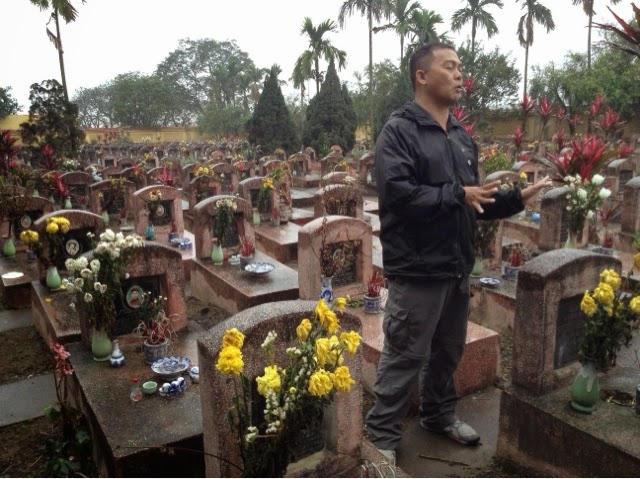
Not far from Hanoi in one of the many military cemeteries sit rows of gravestones each with small altar objects and fresh flowers. Most are regularly tended to by family members. In this culture of ancestor worship and reverence for the dead, it is a priority. We saw many who died in "The American War," including the brother of a woman who was kind enough to share her family's story. She had five relatives who died in that fighting. She embraced some of the women in our group to say goodbye. There wasn't a dry eye.
Whether or not we want to admit it, we travel with preconceived notions. What we found in Vietnam in no way fit into our thinking: Hanoi, Da Nang, Viet Cong, Saigon had only been loaded words blared by TV newscasts, leftovers
festering from decades ago. The discovery and serendipity in travel helped us learn about the warmth many Vietnamese feel towards Americans. It was difficult to understand the often expressed forgiveness for the human and ecological destruction wrought by the U.S. but the people we spoke to do not want to look back. They are putting their energy into a future for their country. Is it the unconscious presence of Budda threaded through the culture, even in a society that does appear to be religious? It was refreshing to observe this resilience, and reminded us about the positive power of forgiveness.