Monday, March 21, 2016

Kangaroos, Koalas, Birds, and a Tasmanian Devil thrown in


Of course! These Roos are not skittish and let people feed them by hand.

These cute little guys are reclusive and hard to spot. A tracker scoured the park before we arrived and sent GPS locations and left pink ribbons for our guide to locate them for us. They sleep 20 hours a day and often stay in the he same group of trees for awhile.


Young dingo


A real Tasmanian Devil. They are rare now due to an unstoppable nose cancer.

This Pelican downs several fish in one gulp.

Emu dads sit on the eggs and take care of the young.


Scarface the Croc as seen on a Croc cruise

Sunday, March 13, 2016

Aborigine culture


Shocking, but true. Australia had an official policy for many years that was Whites Only. The  European  settlers took over indigenous lands stating that they were devoid of people. Half caste children were eventually born, then stolen from their parents and sent away to boarding schools in an attempt to acculturate them as whites. Many did not see their families again.
We spent a morning with a man named Lindsey, one of these children. White skinned and blue eyed, he considers himself an Aborigine, because his proud family culture dictated his upbringing.
With Lindsey and a traditional painting he created

 He related how his sons and other teens "become men" in traditional initiation tests and ceremonies. Throughout their lives they can return to endure more tests, which involve cutting wounds into their bodies, scars being badges of bravery and commitment. Lindsey had (or has ?) six wives and one son with each. A photo of three first cousins showed one vey blonde boy, one dark, and one in between. He explained that the white genes are dominant and that in one generation offspring can be white as the Aboriginal gene is weaker. I don't know if this is true, but will try to check it out.
In 1972, a long overdue  public apology to the indigenous peoples was pronounced by the then prime minister for all of the atrocities and racism over hundreds of years. In the communities , often rife with poverty, addiction, crime and unemployment there is still much to be done to equalize their citizenship. It is a complicated issue which has some parallels with American treatment of native peoples and Afro Americans.
We soaked up all we could about the indigenous histories in a few excellent museums.
The Melbourne Museum, the National Victoria Museum in Federation Square, Melbourne, and Adelaide's Museum all presented various aspects. An A+ goes to the Adelaide collection of beautiful artifacts (especially the scores of exceptional baskets and shields) and the interspersed historical video clips of all aspects of cultural life. One cant help but be impressed by the ingenuity of these traditional people who had such limited resources but who lived well off of the barren and difficult land using everything nature offered.
 
They learned how to make medicines from plants, how to grind seeds for food, how to make spears and boomerangs, how to attach objects together with glue from animal sinew, and so much more. The land was their pharmacy, hardware store, grocery and spiritual center. Their reverence for the earth and the knowledge that they are one with their land is so deep seeded and central to their being that their removal from it created scars that may never heal.

Uluru and Kata Tjuta 
With the Youngermans and our guide Jak

The famous rock, formerly known as Ayers Rock, and its neighbor Kata Tjuta preside over the center of Australia, holding court approximately a four hour drive from Alice Springs. The area is the most sacred ceremonial place for the Aboriginal people, who have lived in Australia for over 35,000 years. How ironic that their land was "given back" to them in 1985. As a World Heritage site, the property has been a cooperative venture with the government under a board of directors, three quarters of whom are Abiriginal. Now only Aborigines are allowed to live there. The tourist industry is healthy, but regulated. Only certified guides are permitted to give tours or even information, in order to insure that the respect due the ancestors is maintained. 
Sacred water hole

Driving around the two structures, walking on paths in permitted places ( various are so sacred and reserved for ceremonies) and being present for sunrise and sunset was a true honor.


Our group was surprised with a lovely champagne reception at the sunset viewing spot.


We as guests of this ancestral people were touched by the stories of creation, tales of how the animal spirits created the rock's markings, and the wall paintings used as visual learning tools.


After getting up at 5 am to witness the sunrise over Uluru, and in addition the Southern Cross, Venus, Mars, Jupiter and Saturn, we were later privileged (in 100 degree heat!) to be able to walk up the gorge on Kata Tjuta. It was a round trip of about an hour, and well worth the trouble. It is possible to walk up a path on Uluru, but the tribe does not want people dong it in order to not violate the respect for the sacred place.


Thirty years ago when David was 8, his third grade class studied Australia for Folk Fair. His assignment was to report on Ayers Rock. I had never heard of it before, but of course was fascinated by the subject enthusiastically relayed by this young mate dressed up as an outback ranger with a red neckerchief. Twenty or so years after his report, he had to see it for himself, and went on a sojourn there. A favorite photo of him shows his back to the camera in silhouette gazing at his old red friend, the majestic rock . In solidarity...

Aboriginal art


Their paintings typically refer to objects in nature, their culture, or their traditional stories. We are wild about them! There are repeated symbols and motifs such as round objects depicting billabongs (water holes), animals, journeys, etc. The simplicity combined with design elements, color, and the stories they tell make for very appealing art. The museums had exceptional examples, but so did the main street, Todd Mall, in Alice Springs. Viewing the art galleries was a dizzying experience. We deliberated for a long time at the Papuna Tula Artists gallery, a cooperative who gives back to the community. It was difficult to narrow down the choices that all wanted to follow us home, but we eventually did buy several modest sized pieces of this unique modern art. Also selling on the street were Aboriginal women with their paintings spread out beneath trees. We felt it was important to meet them and buy   directly from these artists as well.


Aboriginal women selling their paintings


The Aborigines used natural substances to create body paint in several colors.


Tassie and Melbourne

Tasmania. A place, when mentioned to Americans, brings a chuckle and an inquiry about hunting for Tasmanian Devils (made popular by a children's cartoon of the 60's). Off the radar to North Americans, they ask, is it a country? A city? Buzz. The jeopardy question is: what is an island state in Australia off the east coast, a one and a half hour flight from Melbourne?
We might not have ever ventured there except for the desire to see friends we met through Arielle's work buddy, Jane. We became acquainted with The Moores when they visited Milwaukee to see Jane play Australuan football. It was a perfect opportunity to see them again and learn about their beloved Tassie.
First of all, it is beautiful. There is a calmness, even in the main city, Hobart. Considering what they consider heavy traffic, the impression is that life is less hurried , less plastic, less stressful than we know it. We did see some outlets of the multinational chains, but the roads and neighborhoods are populated with more small businesses than we are used to, not garish strips of shouting neon. There is an impression that the best part of the 1950s has been held onto.
A short ferry ride took us to MONA, the Museum of Old and New Art, an unusual and magnificent structure housing ancient relics and wild contemporary art side by side . The current exhibit, Gilbert and George, is controversial at best. Our hosts also introduced us to The Botanic Gardens, and to the lookout on top of Mt. Wellington.
A long drive through the countryside, navigated deftly by Ken at the helm took us on a perimeter road circling the irregular land masses south of Hobart through small villages on the coast. My favorite town name is Cygnet. Sparkling coves full of sailboats, vacation cottages, and adjacent pasture land for future lamb sausages filled in the serene visual landscape. There were no ugly billboards or annoying signs disturbing our respite. This entire area had been engulfed in a devasting fire in 1967, which is the reason so many of the "new" structures are no longer built from wood. In the wooded areas, denuded and stripped trees are still evident. A serendipitous stop at a small but very professionally curated area museum documents the inferno.
Lucky us, we were in town for the once a week Salamanca Market. A long street near the docks fills with tents of vendors selling crafts, gourmet jams, Tasmanian honey, fancy soaps etc and of course second hand books and some antiques. We sampled flavorful coffee while strolling and viewing in the midst of noticeably mild mannered crowds. There was even an exhibit by a car club of reconditioned Fords from the 1950s.
A highlight of the two days in Tassie was the evening planned by Jenny and Ken at their beautiful home in New Town, a part of Hobart a few minutes from the downtown. They invited (cajoled?) Ken's barbershop quartet buddies to attend and perform at their BBQ. Lovely people!
Not knowing much about our own uniquely U.S. musical tradition, we learned about the history and current international barbershop subculture. Imagine Japanese and French groups performing at the annual competition in the US every July, in English! We were smitten and hooked! They delighted us with favorites old and new and we could have stayed all night listening. The rest of the evening we were engulfed in fun and warm hospitality, and regretted not having enough time to talk to everyone more. Kudos to Jenny who made a Pavlova dessert, an extradinary creation of merengue, cream and fruit.
 

Melbourne

This city is what Chicago should wannabe. It too has a central loop, surrounded by magnificent skyscrapers, a navigable River, memorable bridges and river walks, world class museums, botanic gardens, festivals, seemingly endless city sprawl, and amazing multicultural restaurants. One difference is a cohesive downtown in a fairly contained area with an encircling FREE and efficient transportation system by tram, which takes natives and tourists alike to the main arteries for work, cultural institutions and entertainment. There is also one "ground zero" center of town at Federation Square, a modern plaza of museums, venues, tourist assistance and crossing tram lines. Our five days here have been full, easy to get around and safe.
 Some highlights:
The Queen Victoria Market is a few football fields worth of space for exotic food, produce, Aussie flea market products. We swooned while eating our Borek rolls of cheese and spinach.
Several times we ambled in and out of the miles of covered arcades and lane ways inside the downtown loop. These are similar to what are found in London or Paris, full of cake and chocolate shops, small Aussie bars, and fancy goods. We happened upon a Dr Seuss print store. Jim walked in and saw a photo of his cousin in Chicago! It turns out that this cousin is the art dealer who has the license for Dr. Seuss art! The shopkeeper knows him and was as surprised to meet Jim as Jim was to come across the photo.


We walked through the Botanic Garden (lush fern gully), and the nearby imposing war memorial. The river walk offered various points of interest, including walls of immigrant statistics by country. Britain, Ireland and The Phillipines counted the majority of new Australians. Beautiful bridges over the river contrasted with the varied and quite artistic facades of the newest tall buildings nearby. Certainly the architects must have been in competition with each other to design the most colorful, playful and head turning constructions. Few hum drum skyscrapers here.


Many of the buildings have a long triangle motif embedded somewhere in the architecture. Curious. We also stumbled across a number of eagle sculptures. Turns out they are related. The creation story of the Aboriginal people involves a sharp tail feather.


Our favorite eating experience was in Hardware Lane, wide enough to have a comfortable and busy outdoor cafe scene, which made us think we were in Rome for awhile. Note the Max restaurant on Hardware. We also enjoyed a Greek food on the street of Greek restaurants, 

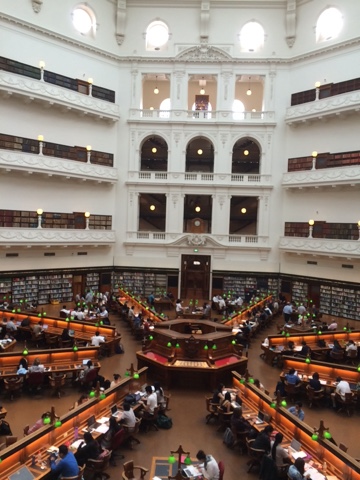
Also downtown is The Victoria Library , a gem of a building with a magnificent dome.


Tuesday, September 22, 2015

Bolechiv, Ukraine 9/8/15


David Neubauer 1887-1973
Our journey to this former Austro-Hungarian (and at one time Polish) town was not because it was brought to light by Daniel Mendelsohn's best-selling book The Lost; The Search for Six of Six Million.Traveling with my husband, Rich, brother Bruce Gendelman, and daughter Sarah Taus, we knew this town was decidedly not a tourist destination, but only coincidentally the birth town our grandfather. It was the place of occasional family lore, the one spoken of with a wave of a hand, motioning disappointment and dismay. 

David Neubauer, when he commented on his post college grandchildren embarking for their rite-of-passage-European-vagabond travels, dismissed us with "What's to see in Europe? I lived there, and I can tell you it's NOTHING." Leaving Bolechiv In 1912 he found his way to America and did not return. He never saw his parents, siblings, or nieces and nephews again. Even the Red Cross could not tell him how they vanished.


The nearest large town in Ukraine with an airport is Lviv, formerly Lemberg.  In a van with a driver, and our guide/genealogist Tomasz J we set out to drive the hour or so south from Lviv on the most dismal of days. Of course. How could our image of this place of so much destruction and engineered evil be anything but the dreariest of wet, dark greys? The road approaching Bolechiv is not in good repair, so the cautious driving around the potholes and bumps allowed us to have more time to observe the dwellings and fields, generally not prosperous, in various states of modernity. Could this have been grandpa's neighborhood? Did he swim in that pond? Did he play near those trees?


artifacts in the Bolechiv museum
                                       
BOLECHIV MUSEUM
I had asked our guide to make one of our stops the local library, hopeful that we could uncover some family information. In The Lost, several survivors reminisced about a Jewish restaurant named Bruckenstein's and I wanted to find it, or at least the former location.  My grandfather's mother was Rachel Bruckenstein, and we know Rachel toiled endlessly in a restaurant of sorts attached to a provisions/grocery store popular with hunters ( including Franz Josef!) on their way to the nearby Carpathian Mountains. Could this have been THE restaurant?  Was she part of an extended restaurant family? Her husband, Baruch Neubauer, grandpa's father, was not thought of well by his children as he left all the work to his wife while he studied Talmud all day. The small town library was not yet open, but the museum attached to it at the rear, was. We were welcomed in and given the option of looking around ourselves or taking the tour for $2.00 for all of us.  With the translation help of Tomasz, we listened to a narrative in the five rooms full of wooden artifacts, embroidered costumes, newspaper articles and plaques, most from the century past.  The docent had never heard of Bruckenstein's restaurant, so she called an older resident for us. But no luck.
Bolechiv Library
Rich, Nina, Bruce
She helped us find requested information about violin making in Bolechiv, as some of our ancestors were violin makers. We learned that the museum and library had been the home and clinic of Dr. Blumenthal, a gynecologist. before it was taken from him. How many happy women passed through those doors, how many bright promises of new life were confirmed under the same roof where now the history of the town had only minor mention of the vibrant Jewish lives there?  The museum caretaker proudly announced that the townspeople took care of their Jews as best as they could. The Jewish population of Bolechiv before the war was approximately 3,000, which was 78% of the total. After the war, only one returned of the approximately forty eight who survived by hiding or escaping to the woods.

THE FIRST "ACTION"


The Dom Katolicki, Catholic Community Center in the center of town was the location of the first large scale"action" of the Nazis against the Jews. I assume it was in this place because it was a the large building, other than a church. Rounded up on the streets and in their homes, the professionals, academics and community leaders, including women and children, were herded into this building and tormented for several days.The unspeakable acts are chronicled in The Lost and I will not repeat them here. After cruel and inhumane treatment, the Jews were taken to a place in the woods, Taniava to be buried in a pit (more below). After the war the community center became a movie theater. The theater burned down. The roof collapsed, as if the pent up guilt finally exploded and burst the rafters from the shameful weight of the crimes perpetrated there. Amidst the rubble, a solitary brick wall remains; a tall flattened witness, with a spectral stare, frozen in muteness.


A KILLING FIELD: TANIAVA


We had difficulty locating Taniava in the heavily wooded road leading away from town. There are no signs.  Local people we stopped on the road suggested driving either further or the other way.  Eventually we spotted a break in the trees with a small grassy entrance to the forest.  Bruce and Tomasz walked one forest path and the rest of us walked the other.  Apparently, used as a clandestine party spot, as evidenced by rubble, there was no indication we were near a memorial.


Within a few minutes we heard a distant call from Bruce, and hacked our way through tall weeds to find a large clearing with a short concrete rectangular fence. Jutting into the middle of the fenced area was a jetty like structure with a memorial plaque.  Indeed, this was the infamous pit where 950 Jews from the Bolechiv area ended their lives. The plaque had been placed there in 2009 by a group of descendants who traveled there to honor their families.  www.bolechow.org 

 On our way out we spied a small stone marker on the road to indicate that the memorial was directly through the woods, although there was no path there.
This sad place, surrounded by peaceful forest could well be the burial ground of our great grandparents, aunts, uncles and cousins.  We will never know. We said  a tearful Kaddish for them and all the other innocents.
Bolekhiv_tour_025


BOLECHIV CEMETERY
The Jewish cemetery is only accessed through a farmer's private property. After a tip from a passerby on how to enter his yard, we rang his house doorbell, only to have him emerge like an angry hornet. Tomasz translated the problem. Jews who visit have been asked to please arrange for a sign with his phone number so his fence isn't broken into, and so he can escort people to the gate of the cemetery in the back of his property.  He was quite agitated that everyone promises to do this, but with no result.  We also promised, and later went with him to the local fast sign shop to place an order for the sign.


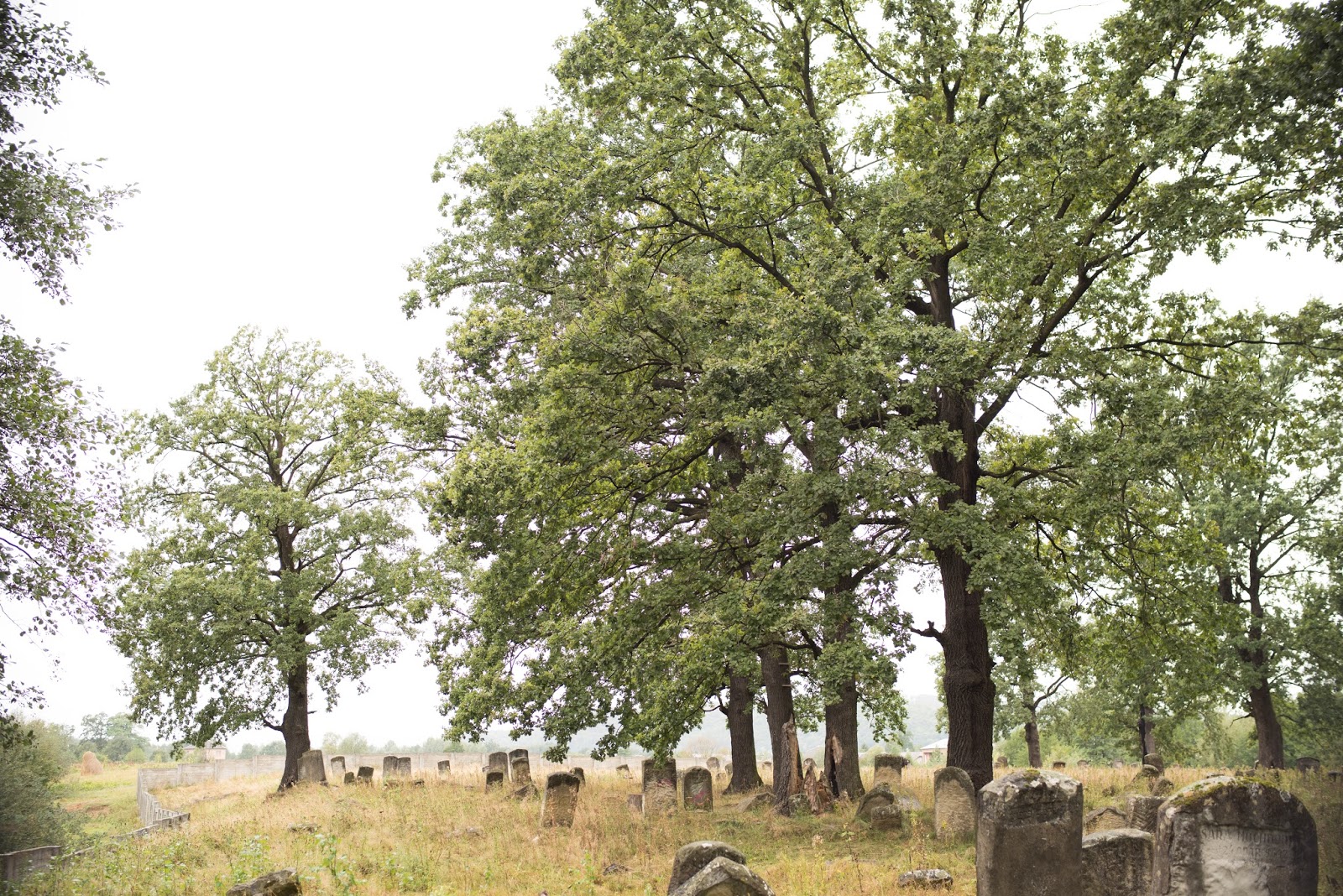
The cemetery is quite large, perhaps a quarter to half mile square (not sure of this estimate). It has existed from the 17th century. Again, there was a plaque set by the same group in 2009, who also was responsible for the fence.  Of course many of the tombstones are weathered, most are fallen and others broken. Compared to other cemeteries we observed in Poland and Ukraine with impossible vines and high weeds, it was better kept. From afar, squinting, it could have been a grassy pasture with big black cows resting in a field. It was unsettling knowing that the sparseness was probably a result of vandalism, antisemitism, and neglect because there were no Jews left to care for the graves.


Tomasz, who had previously searched the cemetery database for us said it would be impossible to find any relatives as the custom on the front of the gravestone was to put X son of Y without a last name. I had worked with Tomasz, over the previous six months delving into my family's genealogy. He extracted the records from various Polish and Jewish databases and had organized our family trees into an Israeli site MyHeritage.com. I think he knew the members of my family better than I did! I carried a print out of the family tree with us. Little did I know how this association would lead to a remarkable event.


Bruce, an adventurous and skilled photographer, ventured far into the cemetery enclosure to take some shots.  The rest of us walked around marveling at some of the ornate stonework, but eventually stopped to rest and wait for Bruce. Where we had stopped, quite by serendipity, Tomasz, who reads Hebrew and Yiddish, asked me to look at the back of the grave I stood next to.


Some graves had family names on the back. This one read 

BRUCKENSTEIN

On the front, we found the first name, Josef Ber, the earliest name we knew of in our family tree. We were stunned and so excited together. I do not think I will forget that moment for the rest of my life. Of all the graves, most in disrepair, fallen, or buried under grass, to stop in front of this one and find the name of my great-great grandfather has left me in a state of shock and wonder. What a privilege to share the moment with my daughter Sarah, this man's great-great-great granddaughter. And Bruce, and Rich.  To whatever hand has played a part in this I am grateful.


Josef Ber Bruckenstein, son of Israel Iser


BOLECHIV SYNAGOGUE


Did the members of the Union of Lever Makers hear the echoes of rejoicing with bride and groom, of hearty mazel tovs to proud Bar-Mitzvah boys, or of anguished mourner's sobs for lives cut short? When the Jews no longer existed in Bolechiv, when a synagogue was no longer necessary, the stately German architectural gem with tall rectangular windows and large circular windows watched gatherings of a different purpose. The sign for the lever makers is placed high on the front facade.  But this ediface has "yichas." There is no mistaking what it was, and the respect that it is owed.

Tomasz spoke to a neighbor who told him he could get a key from the city hall across the street.  He came back empty handed.  The person who holds the key was not at available.


photos by Bruce Gendelman, Sarah Taus and Nina

LINKS
https://en.wikipedia.org/wiki/Holocaust_in_Bolekhiv
www.bolechow.org
http://www.danielmendelsohn.com/
www.youtube.com/watch?v=3XX0c9jbyFk